

This course is full of Kumamoto's attractions. Recommended for those who want to dig deeper into Kumamoto.
1hr 25min. by car

*Currently, Eruption Alert Level 2 is in effect, and the area within about 1 km of the Nakadake crater is off-limits. Crater viewing is not available, but visitors can access the area up to Aso Sanjo Hiroba (the summit plaza). Please check the latest information before visiting.
The Aso Caldera is one of the largest calderas in the world, measuring about 18 km from east to west, 25 km from north to south, and about 100 km in circumference. At its center rise the Five Peaks of Aso (Aso Gogaku): Mt. Nekodake, Mt. Takadake, Mt. Nakadake, Mt. Eboshidake and Mt. Kishimadake. Of these, Mt. Nakadake is still active. From the edge of its huge crater, about 600 m in diameter, 130 m deep and 4 km in circumference, visitors can see white volcanic plumes rising and dramatic volcanic scenery up close.
*Access to the crater may be restricted depending on volcanic gas, volcanic activity and weather conditions. Please check the website below before visiting.
Aso Volcano Crater Restriction Information (Aso Volcano Disaster Prevention Council)
4min. by car
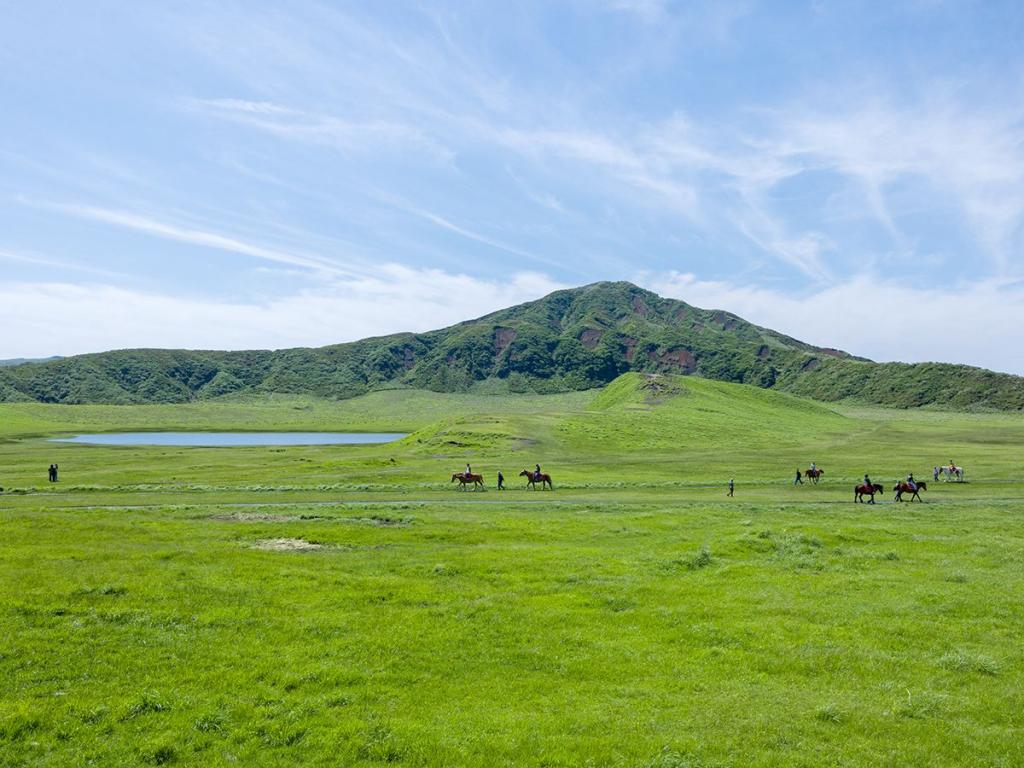
Kusasenri is one of Mt. Aso's most iconic sightseeing spots. This vast grassy plain sits at an elevation of about 1,100 meters, where horses graze leisurely and visitors can take in sweeping views of the active Nakadake crater sending up volcanic plumes. Its scenery changes with the seasons: in summer, the grasslands glow a vivid green, and in the depths of winter, the area can be blanketed in snow, creating a magical white landscape. Kusasenri is also one of the highlights of the Aso UNESCO Global Geopark.
Visitors can also enjoy horseback riding and hiking. The parking area of Kusasenri is home to the Aso Volcano Museum, as well as cafes, restaurants and souvenir shops.
★ Rules at Kusasenri
The grazing horses can be dangerous. Please observe the following:
1. Do not approach the horses
It is extremely dangerous to get too close to or touch the horses. Please do not touch them under any circumstances.
2. Do not make sudden movements or loud noises
Horses are easily startled. Please avoid sudden movements or loud sounds that may frighten them.
3. Do not feed the horses
Feeding the horses is prohibited. To protect their health, please do not give them any food.
33min. by car

Mizuki means a fountain, and there are springs called Mizuki on Ichinomiya Monzen Shopping Street. The water is prized as delicious, mellow consecrated spring water and worshiped as water which gives perpetual youth and longevity. Inhabitants in Ichinomiya have appreciated the consecrated water daily and lived with it. Because they thought more people should drink the beautiful water, they have built 14 wooden or stone fountains since around 10 years ago and let people who pass by drink the water.
Besides, because most of the fountains are located along Nakamachi Street near the approach of Aso Shrine, a stroll can be also enjoyed. During the tour of fountains, tourists can take a break at a traditional store or a coffee shop as well.
1hr 1min. by car

Daikanbo is one of the peaks of Aso's northern outer caldera rim, located northeast of Uchinomaki Onsen. Standing at about 936 meters above sea level, it rises roughly 400 meters above the Aso Valley and the town below, making it one of the most iconic viewpoints in Aso.
From here you can enjoy a 360-degree panorama of the town of Aso, the Five Peaks of Aso, and even the Kuju Mountains. The Five Peaks are said to resemble a reclining Buddha when seen from Daikanbo. On early mornings from autumn to winter, you may be lucky enough to see unkai, a "sea of clouds" filling the caldera, with the peaks rising above it.
The viewpoint has souvenir shops and restaurants, and it is also a popular spot for stargazing at night.
1hr 2min. by car
This plateau of wide, green pasture extends over Minamifumoto in the Kuju mountain range from Oita. As far as you can see, there is nothing but a green pasture here.
11min. by car

Nestled in the mountains at an elevation of about 700 meters, Kurokawa Onsen is one of Japan's most popular hot spring villages. Its roughly 30 inns and the surrounding countryside see themselves as "one big ryokan": each inn is a guest room, and the lanes connecting them are its corridors.
Seven different types of spring water flow here, so each inn offers its own distinctive bath. With a Nyuto Tegata (wooden bathing pass, ¥1,500, valid for 6 months), you can choose any 3 of the 25 open-air baths (rotenburo) at the inns; one of the 3 can be used for food or souvenirs instead. Passes are sold at each inn and at Kazenoya, the information center. Photography is generally prohibited in the open-air baths.
In winter (around late December to March), the Yuakari bamboo-lantern illumination softly lights up the village.